
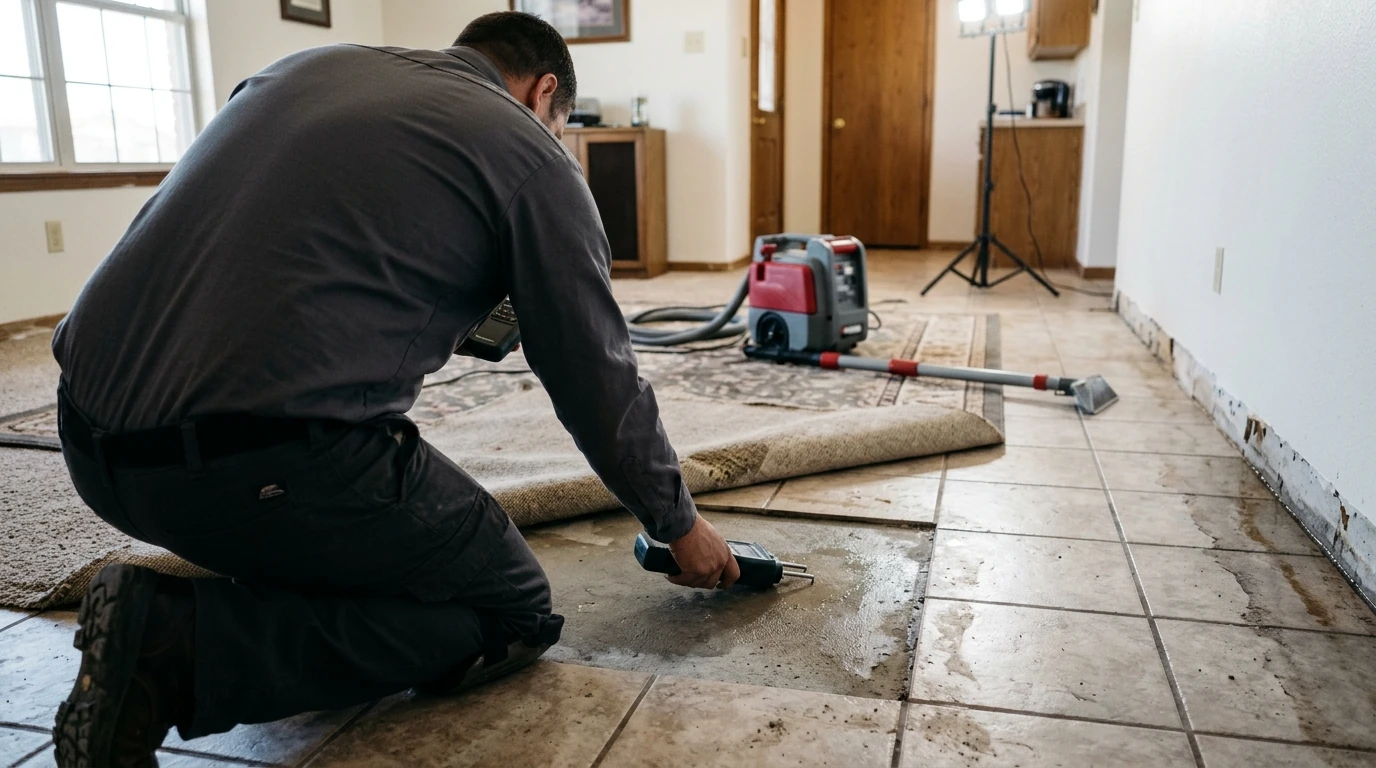
If you just found a warm, damp spot on your tile floor, heard a hissing or trickling sound near the foundation, or watched your water bill spike with no leak anywhere in sight, you likely have a pipe burst under your slab. Call a licensed plumber or leak detection company first to shut off the water and locate the break. Then call ACS Enterprise at (432) 847-4704 for the water removal, moisture mapping, and drying that comes next. ACS Enterprise is locally owned and operated in Midland, licensed and insured, and answers calls 24/7 with a 5.0 Google rating across 367 reviews.
A slab leak is not something to wait out. The longer water sits under flooring and inside wall cavities, the more material has to come out before the house can dry properly. Here is the order of calls that actually protects your home and your insurance claim.
What are the signs of a pipe burst under a slab?
The clearest signs are a warm spot on the floor, a hissing or trickling sound near the foundation when no fixtures are running, wet carpet or flooring with no visible source, and a water bill that jumps well above normal use. Any one of these on its own is worth investigating; two or more together usually means an active leak.
A warm spot almost always points to a broken hot water line, since the escaping water heats the slab and the flooring above it. A cold, damp spot more often means a cold-supply line. You might also notice buckling laminate, lifting tile grout, or a musty smell in one room that was not there before. Running the house meter with every fixture off and watching it still spin is one of the simplest checks a homeowner can do before calling anyone.
Who do you call first, a plumber or a water cleanup crew?
Call the plumber or leak detection specialist first. They isolate the water at the main or a zone valve and pinpoint the exact break, often using acoustic listening equipment or thermal imaging, before anyone can safely plan repairs or cleanup. Once the water is off and the leak is located, call a water damage restoration crew to deal with everything the leak already left behind.
In practice, the order looks like this:
- Shut off the main water supply if you can safely reach it.
- Call a licensed plumber or leak detection company to locate and stop the leak.
- Call a water cleanup crew to extract standing water, map how far it traveled, and start drying.
- Call your insurance company once you have a clear picture of what the plumber found and what the cleanup crew’s scope looks like.
Skipping step 3 to save money is the mistake that turns a one-room problem into a multi-room one, because water under a slab does not stay in one spot. It follows the path of least resistance under flooring and through wall cavities.
Why do so many Midland homes see under-slab pipe breaks?
Most homes in Midland and across the Permian Basin sit on concrete slab foundations with copper or galvanized supply lines running beneath them. West Texas clay soil expands when it absorbs moisture and contracts hard when it dries out, and that constant shifting puts stress on rigid pipe joints buried under the slab.
Over years, a joint fatigues or a pinhole forms from the movement, and water escapes into the soil beneath the house before working its way up through flooring, carpet pad, or grout lines. This is also why the same home can see a repeat break a few years after the first one, often in a different spot along the same supply line. It is a soil-and-foundation issue as much as a plumbing age issue, which is part of why slab leaks show up so often in this part of Texas.
What does a water cleanup crew actually do when they arrive?
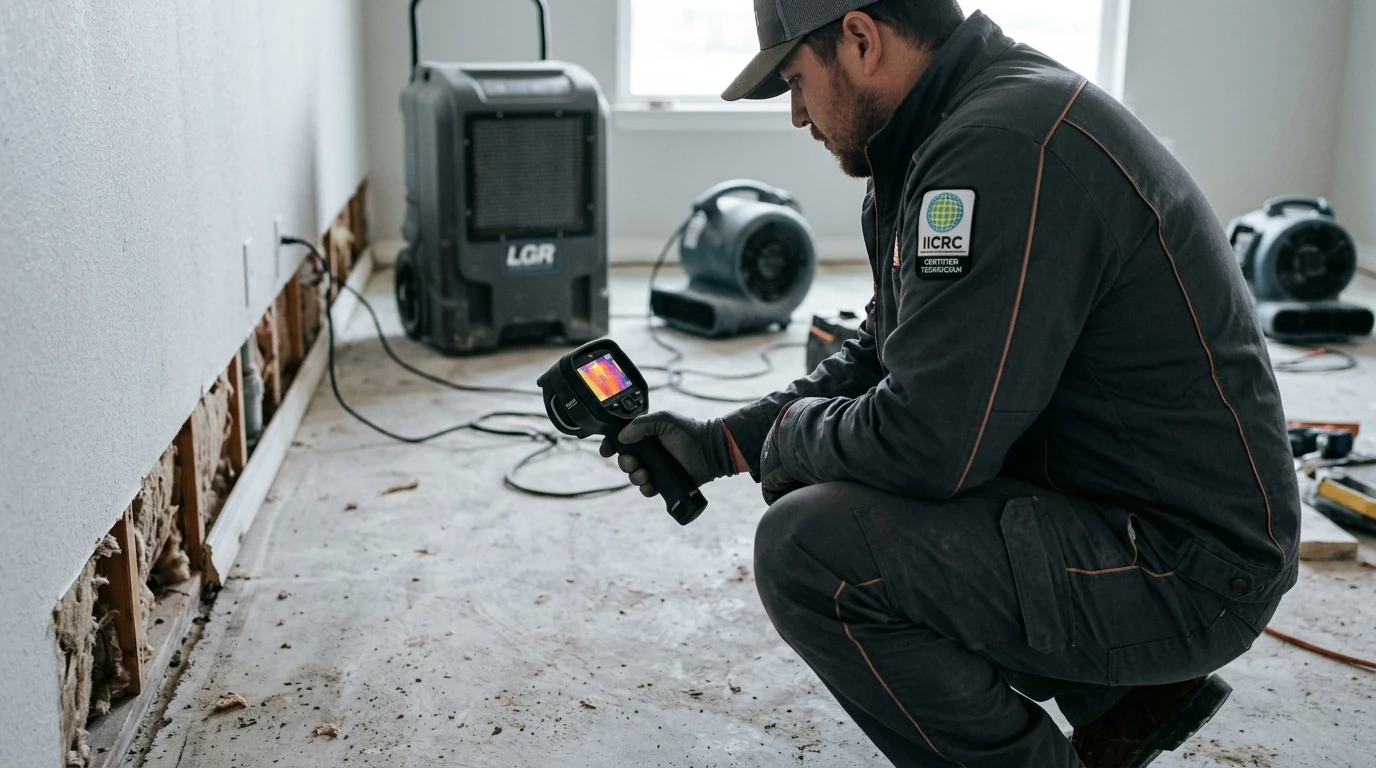
A water cleanup crew maps how far the water traveled, removes flooring that cannot dry in place, and sets drying equipment to bring the structure back to a normal moisture level. This follows the drying principles laid out in the IICRC S500 water damage restoration standard, the industry reference for how water losses should be assessed and dried.
The work usually starts with a moisture meter check across the affected rooms, both on the surface and down into the slab where possible, to find the true extent of the wet area, not just what is visible. Standing water gets extracted with truck-mounted or portable pumps. Flooring, baseboards, and carpet pad that soaked through typically come out, since porous material sitting against a wet slab rarely dries clean on its own. Air movers and a dehumidifier go in to dry the exposed concrete and surrounding framing, with daily moisture readings until the space is back to a dry baseline. Our burst pipe emergency checklist walks through the first-hour steps in more detail if you want the full sequence.
Does insurance cover the repair or just the cleanup?
Most Texas homeowners policies cover the sudden water damage inside the home, meaning the tear-out, extraction, and drying, but typically exclude the cost of repairing the pipe itself. Insurers generally treat pipe repair as a plumbing and maintenance expense rather than an insured loss, even when the water damage it caused is covered.
That split matters when you are budgeting for this. Expect the plumber’s invoice for locating and fixing the break to be a separate, out-of-pocket line item in most cases, while the water cleanup and drying portion may be reimbursable depending on your policy’s terms. Photograph the damage before anything is removed, keep every invoice, and ask your adjuster directly how your policy treats sudden pipe failures versus gradual leaks, since that distinction affects what gets paid. Our homeowners insurance and water damage guide covers the sudden-versus-gradual distinction in more depth, and the Insurance Information Institute has a plain overview of what standard policies generally include.
What should you avoid doing while you wait?
Do not run water anywhere in the house, including the washing machine or dishwasher, until the plumber confirms the leak is isolated. Running water can mask the leak’s true location or add more water to an already saturated area.
Do not try to pry up slab tile yourself to “see how bad it is.” Removing flooring without mapping the wet area first can spread debris and make it harder for the cleanup crew to document the original extent of the loss for insurance purposes. Do not ignore a musty smell that lingers after the surface water is gone; it usually means moisture is still trapped somewhere the eye cannot see. And do not wait a few days to see if it dries on its own. Water sitting under a slab or inside a wall cavity does not resolve itself, and every extra day adds to what needs to be removed and dried.
Once the plumber has the leak located and the water shut off, Call ACS Enterprise at (432) 847-4704 to get moisture mapping and drying started the same day you call, before the water spreads any further under your flooring.