
Tile & Grout Cleaning in Andrews
Tile & grout cleaning in Andrews, TX. Insurance billing accepted. Call (432) 847-4704.
Our technicians are dispatched from our Midland, TX headquarters and are typically on-site in Andrews within 60 minutes of your call.
Andrews sits in the heart of the Permian Basin, where blowing caliche dust, hard well water, and wide temperature swings between January nights and July afternoons create a particular kind of punishment for tile and grout. Mineral-rich water leaves calcium deposits that bond to grout pores over time, and the fine alkaline dust that drifts in from the surrounding oil fields settles into textured floor tile in ways that a standard mop never fully lifts. If your kitchen, bathroom, or entryway tile looks perpetually dingy despite regular cleaning, the problem is almost certainly what has worked its way into the grout matrix, not how often you clean.
Why Andrews Properties See Tile and Grout Issues
The water chemistry in Andrews County is the starting point. Municipal water drawn from local sources carries elevated levels of calcium and magnesium, and every time that water evaporates off a tile surface, it leaves a microscopic mineral film behind. Over months and years, those films calcify inside grout joints and along the edges of glazed tile, creating a rough surface that traps even more soil. The result is grout that looks permanently stained even when it is technically clean.
The climate adds a second layer of stress. Andrews experiences genuine freeze-thaw cycles in winter, and grout in exterior entryways, covered patios, and garage floors expands and contracts with those temperature shifts. Unsealed or under-sealed grout cracks at the joints, and once a crack opens, caliche-laden soil and moisture work their way in. Left alone, that moisture cycle eventually loosens tile adhesion from the substrate below.
Oil-field work culture also plays a role inside homes. Work boots tracking in drilling mud and petroleum-based compounds are harder on grout than ordinary foot traffic, and standard household cleaners are not formulated to cut those residues.
Our Tile and Grout Cleaning Process in Andrews
The process starts with a dry inspection of the tile field. Grout color, porosity, and existing sealant condition vary by installation era, and what works on a newer large-format porcelain floor is different from what works on older ceramic mosaic tile common in homes built during the 1970s and 1980s oil boom. Identifying the tile type and grout composition before applying any chemistry prevents etching or color shift.
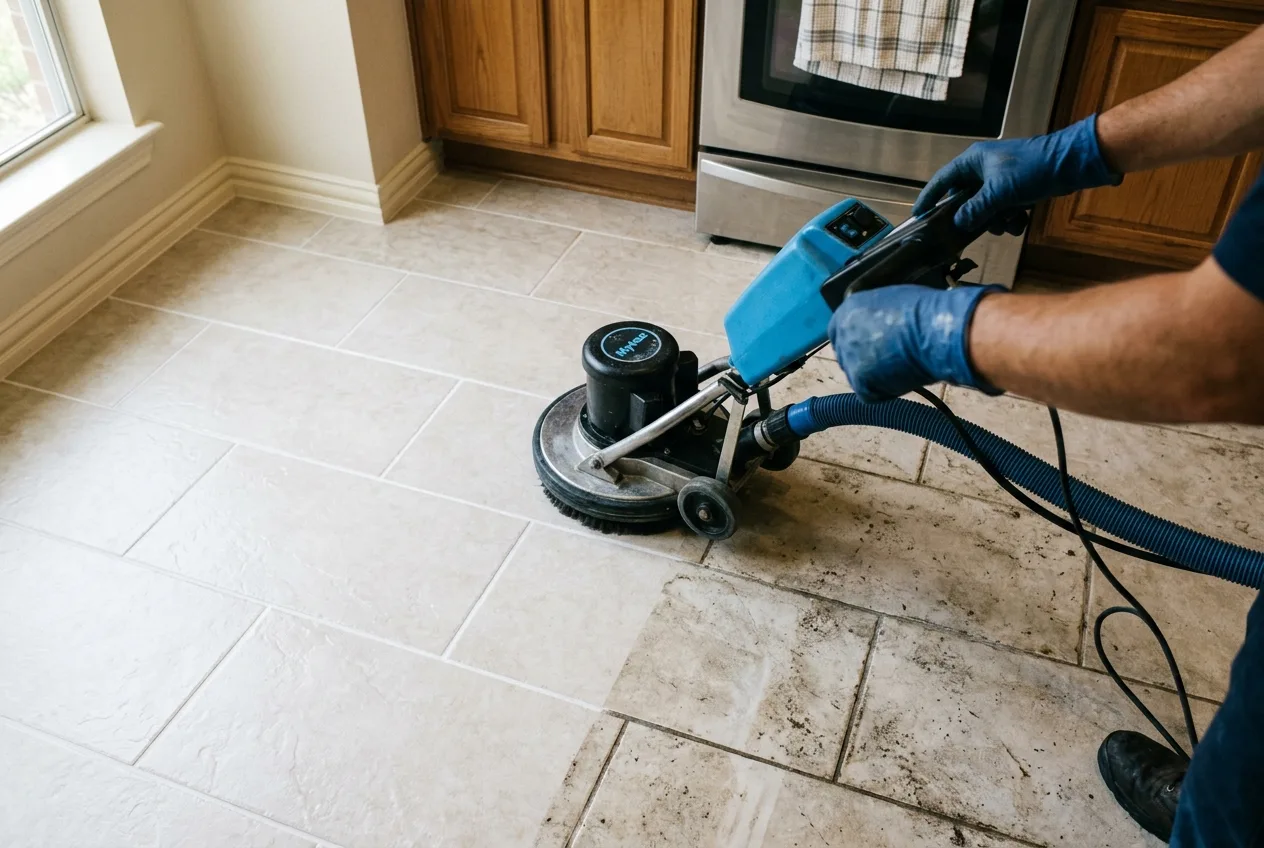
From there, a pH-appropriate cleaning solution is applied and allowed to dwell. High-pressure rotary extraction then pulls the emulsified soil and mineral buildup out of the grout pores rather than simply spreading it across the surface. The difference between this and a standard mop-and-bucket approach is visible: grout lines that have looked gray for years often return to their original tan or white within a single service.
After the grout is clean and fully dry, a penetrating sealant is applied to the grout joints. This step is not cosmetic. Sealed grout resists the mineral deposits and fine dust that are a constant in Andrews, and it dramatically extends the interval between deep cleanings.
Equipment and Methods We Use for Tile and Grout
The rotary pressure tool used for extraction is truck-mounted, which means consistent water temperature and suction regardless of how large the tile area is. Consistent heat matters for breaking down the calcium-based mineral deposits that are especially common here. Portable machines lose pressure and temperature on larger jobs, which means incomplete extraction and faster resoiling.
For grout restoration work, where joints have been physically damaged or discolored beyond what cleaning can correct, colorant application is done by hand with a fine applicator rather than a brush, so the colorant stays in the joint and does not bleed onto the tile face. This precision matters on older tile with narrow grout joints.
Local Note
Homes built in Andrews during the 1970s and early 1980s, when the Permian Basin oil economy was expanding rapidly, frequently used quarry tile in kitchens and utility rooms. Quarry tile is unglazed and highly porous, which means it absorbs cleaning solutions differently than glazed ceramic or porcelain. Aggressive alkaline cleaners that work well on glazed tile can actually darken quarry tile permanently if the dwell time is too long. Knowing that this tile type is common in Andrews-area homes of that era changes how the pre-treatment step is approached, and it is one of the reasons a visual inspection before any chemistry is applied is not optional.
If your home was built during that period and the kitchen or utility room has a reddish-brown unglazed tile floor, mention it when you call. It changes the product selection before the crew arrives.
For tile and grout cleaning in Andrews, reach ACS Enterprise at (432) 847-4704. Whether the issue is hard-water scaling, caliche-embedded grout, or tile that has simply never been deep-cleaned since installation, the process is straightforward and the results are visible the same day.
Serving Andrews from our Midland headquarters — ★ 5.0 · 362 Google reviews
“Quick and easy, picked up same day” — Brian, August 2026Read our reviews on Google →
Tile & Grout Cleaning in Andrews: Service Coverage
Frequently Asked Questions
How fast can you arrive for tile & grout cleaning in Andrews?
How does Andrews' hard water affect how often tile and grout needs professional cleaning?
Can you clean tile in homes built during the Andrews oil boom era of the 1970s and 1980s?
Does the caliche dust common around Andrews cause permanent grout staining?
How long does the grout sealant last in Andrews' climate conditions?
How far is your Midland location from Andrews, and does that affect scheduling?
Will my homeowners insurance cover tile & grout cleaning in Andrews?
Tile & Grout Cleaning response in Andrews
Most Andrews calls see a technician on-site within 60 minutes from our Midland headquarters.